
Ask an engineering team using AI coding assistants how sprint planning feels lately, and a specific complaint comes up more often than "AI is changing everything": the tickets feel fake. A story that used to take three days of real implementation work now takes an afternoon, but it still sits in a two-week sprint next to seven other tickets sized for a world where writing the code was the bottleneck. Story points stop predicting anything. Standups report "still in progress" on work that finished yesterday because the demo isn't until Thursday. Retros surface the same complaint every cycle: the process feels like overhead wrapped around work that no longer needs it.
That complaint is usually followed by a shrug and a plan to just make the sprints shorter, or the tickets bigger, or the standups optional. None of those are wrong, but none of them ask the prior question: what was the sprint actually coordinating, and does that coordination problem still exist? This article treats that as an open question and works through one feature, in enough detail to see where the answer changes.
Why Sprints Chop Work Into Small Pieces
Small tickets inside a fixed two-week box solve three distinct problems at once, and it matters which one you're solving before you decide the box is obsolete:
- Parallelization across specialists. If a feature must pass through a PM, a designer, a backend engineer, a frontend engineer, a QA engineer, and a security reviewer, splitting it into stage-sized tickets is what lets more than one of those people work at the same time—design on ticket 2 while backend starts ticket 3 based on an agreed contract.
- Estimation and risk containment. A two-week box limits how wrong a bad estimate can get before someone notices. Small tickets are easier to size than a whole feature, and a slipping ticket is visible inside a two-week window instead of a two-month one.
- A forcing function for inspection. When real work took weeks per stage, the sprint boundary was often the only scheduled moment anyone looked at the feature together—stand-up, review, retro. Without it, work could drift unseen for a long time.
All three reasons are sound. None of them are about the code being hard to write. They are about coordinating people across a queue, and about managing uncertainty over a long execution window. Both of those conditions can change without the underlying business problem changing at all.
Same Feature, Two Shapes of Work
Consider a concrete, mid-size feature: a workspace's usage dashboard needs an overage alert—when a team crosses 90% of its monthly API quota, email the billing admin and show a dismissible banner in the dashboard, with the threshold configurable per plan tier. It is illustrative, not a shipped Stackable AI feature, but it is the right size to make the comparison concrete: too small to need a research spike, too cross-cutting to be "just a frontend ticket."
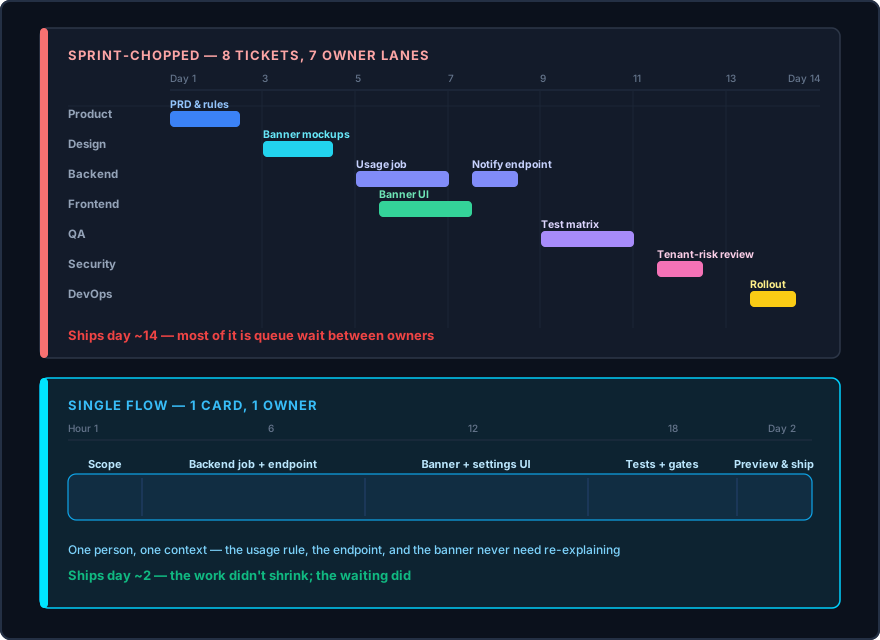
In a conventional sprint, that feature becomes roughly eight tickets: a PRD defining the threshold and notification rules (PM), a banner and settings mockup (design), a usage-evaluation job (backend), a notification-dispatch endpoint and email template (backend), a banner component and settings toggle (frontend), a test matrix for threshold edge cases and tenant isolation (QA), a feature-flag and staged rollout (DevOps), and a review of cross-tenant exposure risk in the usage job (security). Each ticket is individually well-sized and easy to estimate. The feature still takes the better part of two weeks, because each handoff waits on someone else's queue, and the people best equipped to answer a question that comes up mid-implementation are usually in a different ticket by the time it does.
Run by one accountable builder with an AI assistant and the automated verification gates described in our piece on multi-functional builders—contract linting, CI checks, ephemeral previews, and explicit escalation rules for sensitive changes—the same feature does not need eight tickets. It needs one: define the threshold rule and acceptance criteria, implement the job and endpoint, build the banner and settings UI, write the tests for the edge cases that matter, pass the automated tenant-isolation and security checks, and ship through a preview environment. One person holds the full context from the quota rule to the deployed banner, so nothing gets re-explained at a handoff. The realistic elapsed time is a day or two, not because any individual step got dramatically faster, but because the waiting between steps mostly disappeared.
Nothing about the reader-facing feature changed. What changed is which of the three original reasons for chopping the work still apply. Parallelization across specialists is moot—there's one owner. Estimation risk over a long window is moot—the window is now short enough that a bad guess is visible in hours. Only the third reason, a forcing function for inspection, is still plausibly relevant, and it's worth asking whether a two-week box is even the right cadence for it anymore.
What Breaks When the Box Shrinks Below the Work
Most teams' first instinct is to keep the ceremony and just resize it: shorter sprints, or the same two weeks with fewer, bigger tickets. Both are reasonable experiments, but three specific symptoms show up when the box no longer matches the unit of work, and they're worth naming because they're easy to misdiagnose as a discipline problem rather than a structural one:
- Story points stop predicting anything. Points were a relative estimate of effort under queueing conditions—how long a ticket sits in a stage, not how long the code takes to write. Once an AI-assisted builder can draft, test, and ship a feature-sized unit in a day, the variance between a "3-point" and a "5-point" ticket is dominated by noise: how good the acceptance criteria were, not how much typing was involved. Velocity computed from those points stops tracking delivered value and starts tracking how finely someone chopped the backlog.
- Standups become status theater. The daily standup exists to surface blockers between people who depend on each other's output that day. When one person owns a feature end-to-end, there is often nothing to unblock that a Slack message wouldn't have solved faster—the meeting persists because it's on the calendar, not because it's coordinating anyone.
- Backlog grooming turns into premature decomposition. Splitting a feature into implementation-level tickets two weeks before anyone starts it forces decisions—API shape, UI structure—that are cheaper and better made by the person building it, in context, the day they build it. Grooming time gets spent re-litigating design choices that AI-assisted drafting makes trivial to explore live instead.
None of these symptoms mean the team is undisciplined. They mean the ceremony was built to manage a queue that no longer exists at that granularity, and shrinking the box without asking what the box was for just produces a smaller version of the same mismatch.
What Sprint Ceremonies Are Actually For
Separating "coordinates multiple people" from "tracks one owner's subtask progress" gives a usable test for each piece of the ceremony. Applied to a typical Scrum cadence:
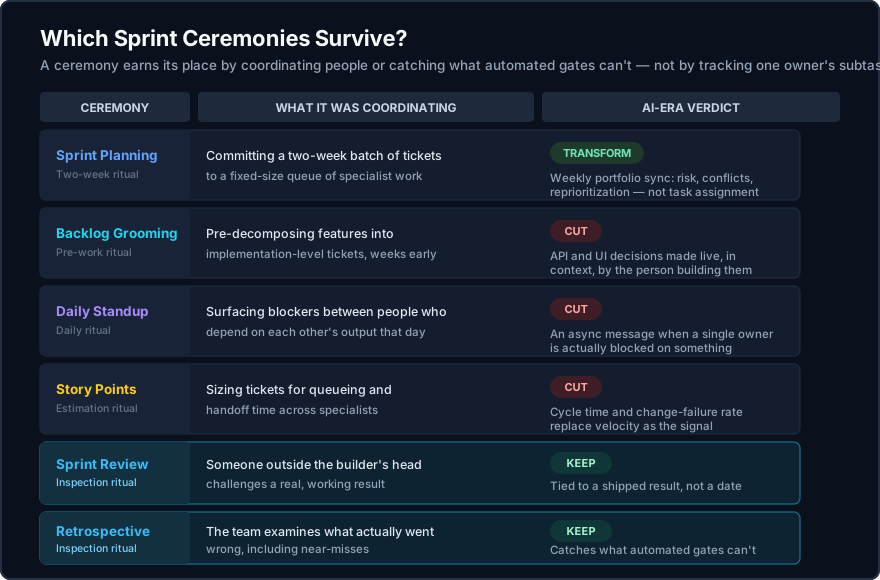
Sprint review and the retrospective pass the test in a different way than planning or standups do: they were never really about task tracking. A review is a checkpoint where people outside the builder's head—a PM, a stakeholder, another engineer—look at a real, working result and challenge it. A retro is where the team examines what actually went wrong, including near-misses the automated gates didn't catch. Both are forms of inspection that a single accountable owner structurally cannot perform on their own work, which is exactly the kind of check the four guardrails for full-lifecycle ownership—contracts, CI gates, preview environments, and escalation criteria—don't replace. Automated gates catch what's specified; they don't catch "this solves the wrong problem" or "we've seen this failure pattern before."
What doesn't survive the test is anything whose only job was managing the queue itself: point estimation calibrated to specialist handoff time, a daily meeting to surface blockers between people who no longer depend on each other's daily output, and backlog grooming that decomposes a feature before the person who'll build it is in the room.
Three Ways to Resolve the Mismatch
Teams facing this mismatch generally converge on one of three approaches, and the right one depends on what's actually generating the coordination need at that team's scale.
- Shrink the box. Keep every Scrum ceremony but run one-week or even three-day sprints. This is the least disruptive change and can work well for teams still building the automated verification gates a faster cycle depends on—the cadence forces regular inspection while that safety net matures. Its limit is that it keeps story-point estimation and daily standups alive past the point where they're measuring anything real, just on a faster clock.
- Keep the box, enlarge the unit. Keep the two-week cadence but stop splitting features into specialist-stage tickets; plan in feature-sized units owned by one builder, and use the existing sprint boundary purely as a review and reprioritization checkpoint. This preserves the planning cadence that stakeholders and dependent teams rely on, at the cost of sometimes finishing a feature four days into a ten-day box with nothing else queued and ready.
- Flow plus a portfolio sync. Drop the fixed iteration for individual features entirely: a builder scopes, ships, and closes a feature-sized unit whenever the guardrails clear it, with no ticket subdivision. Replace the sprint boundary with a recurring, lighter-weight sync—weekly is a reasonable default—focused only on what a single builder can't see: cross-feature conflicts, risk escalations, and roadmap reprioritization. This captures the most latency, but it asks the most of the guardrails, since there's no fixed checkpoint forcing inspection if they're weak.
None of these is a universal answer. A team without solid CI gates and preview environments yet should probably shrink the box first and earn its way to flow, not skip straight to it.
Where Flow-Based Shipping Breaks
The flow-plus-sync model is the one with the most upside and the most ways to go wrong, so it deserves the most scrutiny rather than the most enthusiasm.
Conditions That Would Make This the Wrong Call
This is a hypothesis about coordination cost, not a claim that fixed iterations are obsolete. It would be wrong for a team where: multiple builders routinely touch the same shared system in the same week, and conflicts surface as production incidents rather than merge conflicts; the org has no reliable weekly cadence to catch scope drift because "whenever it's ready" quietly becomes "whenever," and features stop shipping visibly; or delivery requires a multi-party, dated sign-off—regulated software, contractual milestones—that a continuous stream of small releases can't satisfy on its own.
Three specific failure modes are worth watching for directly. First, concurrent collisions: without a shared planning boundary, two builders can independently and reasonably decide to touch the same billing table or shared API in the same week, and the first anyone hears about it is a merge conflict or a production incident, not a planning conversation. Second, single-owner fragility: a builder who carries a feature end-to-end also becomes its only source of context, so review coverage and documentation discipline have to be enforced deliberately, or the team quietly recreates a bus-factor-of-one for every shipped feature. Third, reprioritization drift: a fixed sprint boundary forces a recurring conversation about whether the roadmap still makes sense; flow without a disciplined portfolio sync can let a team ship efficiently in a direction nobody re-validated in a month.
Each of these is a reason to keep a specific, named check—not a reason to keep the two-week box wholesale. A shared-systems change log and a lightweight "who's touching what this week" post catches the first. Mandatory second-reviewer sign-off on anything touching authentication, billing, or data retention catches the second, echoing the escalation criteria from the guardrails piece. A protected weekly portfolio review that stakeholders actually attend catches the third.
A Decision Rule, Not a Verdict
Rather than a prescription, three questions can sort a team's existing ceremonies into keep, cut, or transform:
- Does this ceremony coordinate more than one person's work, or does it track subtask progress for a single owner? If the latter, it's a candidate to cut—a status update to nobody isn't coordination.
- Does this checkpoint catch something the automated gates structurally can't—a wrong problem, a business risk, a pattern the team has been burned by before? If yes, keep it, but tie it to a shipped result, not a date on a calendar.
- Does this boundary serve a planning need that exists independently of any one feature's speed—budget cycles, cross-team dependencies, external commitments? If yes, keep a recurring sync at whatever cadence that planning actually requires, decoupled from how any single feature is built.
Applied honestly, this usually cuts story-point estimation and the daily status standup, keeps something like sprint review and retro in a lighter form, and replaces the sprint boundary itself with a portfolio-level sync sized to the org's actual planning cadence rather than a two-week default inherited from a slower era.
This is a hypothesis, and it's falsifiable in an ordinary way: run one team on flow-plus-sync for a full quarter against a comparable team that keeps sprints, and track cycle time from decision to production, change failure rate, and incident rate tied to cross-feature conflicts—not tickets closed or points burned. If the flow team's incident rate or rework climbs relative to the control, the coordination the sprint boundary was providing was real and under-priced, and the box should come back for that team, in whatever size actually fits the work.
Train Your Engineers for the Full-Lifecycle Model
Eliminating handoffs requires engineers with the systems discipline to own the entire cycle. Our hands-on classes equip developers with the technical rigor needed to build independently: executable specs, automated verification gates, type-safe schema contracts, and zero-idle cloud deployment.
Explore the Engineering Curriculum →