
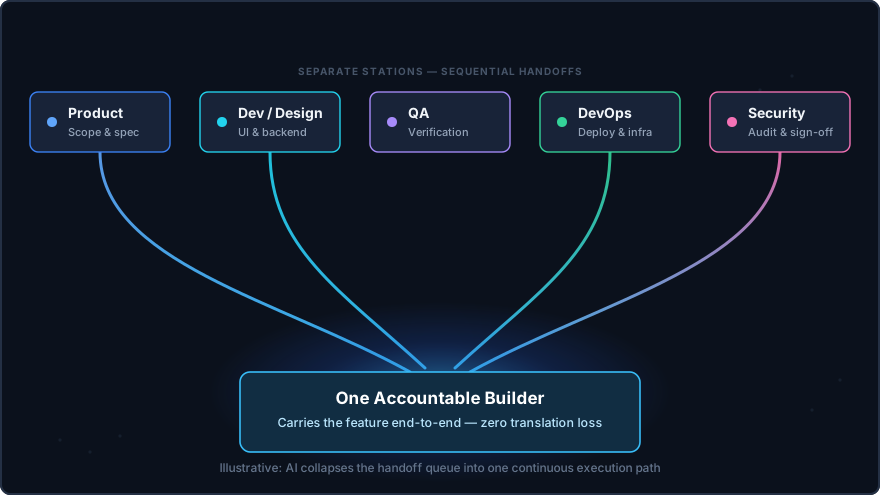
For over twenty years, commercial software engineering operated under an industrial metaphor: the assembly line. A product manager wrote a detailed requirements document. A designer translated it into static mockups. A frontend engineer implemented the interface. A backend engineer built the services. A QA engineer authored test matrices. An infrastructure engineer provisioned environments and pipelines. A security engineer reviewed the architecture, threat model, and mitigations for sign-off—sometimes late enough to force rework.
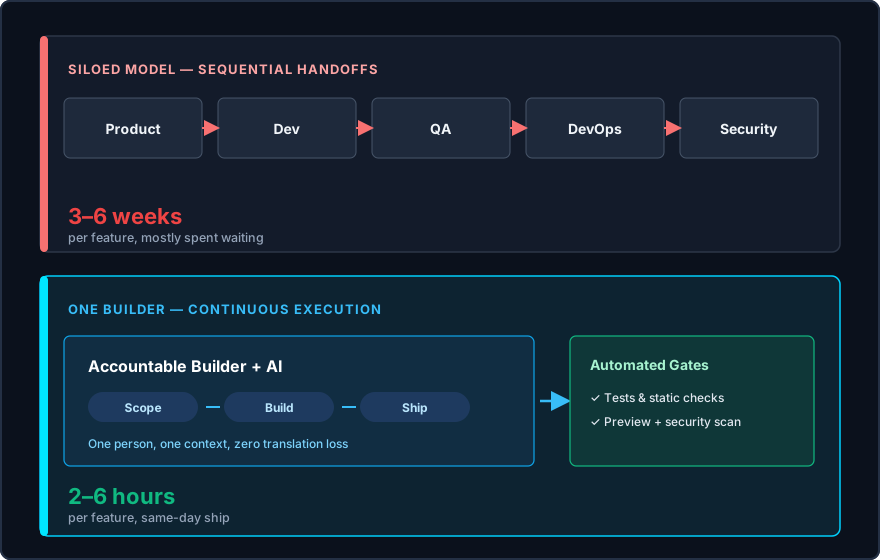
Each station on the assembly line existed for a logical reason: the cognitive burden of mastering every layer was genuinely prohibitive for one person. But that specialization came with a tax: handoff queues, context loss, and translation latency. In a queue-heavy organization, a feature with hours of active work can take weeks of elapsed time to reach release.
Generative AI and agentic coding workflows weaken a core assumption underlying that assembly line: one specialist no longer has to produce every first draft. That creates room for an engineer to carry a familiar feature across phases, but only when the team also defines decision rights, reusable paths, required checks, and risk-based reviews. Faster drafting creates the opportunity; process design removes the wait.
The Handoff Queue Tax
To understand why role transformation is occurring, look at the gap between active work and elapsed delivery time. In a queue-heavy process, a feature can spend more time waiting for the next handoff than being built:
- Requirements drift: The engineer discovers edge cases the spec never covered, triggering multi-day asynchronous clarification threads before work can resume.
- Design-to-code impedance: Static mockups do not capture responsive behavior, error states, and interaction dynamics—leaving those decisions to whoever picks up the ticket.
- QA ping-pong: A tester finds a regression days after the developer has context-switched. Reproducing the original intent requires yet another synchronous meeting.
- Infrastructure bottleneck: The feature is functionally complete but blocked pending environment configuration, access policy setup, or deployment plumbing from another team.
- Late security-review friction: When design review arrives after implementation, architectural findings can force rework right before a planned release.
Every handoff between two human roles is a lossy transmission. Intent gets diluted, subtleties are forgotten, and accountability is diffused across the chain. When a bug reaches production, the developer points to the spec, the PM points to design, and QA points to incomplete test environments. Nobody is lying—the process itself distributes accountability too thinly to act on.
The AI Catalyst: Why Drafting Cost Collapsed First
Why didn't broader individual ownership of the software lifecycle emerge earlier? Because producing competent initial drafts across five or six different disciplines was genuinely prohibitive. Writing correct backend logic, constructing accessible UI components, expressing precise test assertions, wiring deployment configuration, and reasoning about security implications are each demanding—and they require different vocabularies, mental models, and toolchains.
AI does not replace human domain judgment. It can sharply reduce the blank-page drafting cost. An engineer working with an agentic coding assistant can now:
- Start from a PM's customer outcome and decision boundaries, then draft acceptance criteria, edge cases, and possible user flows for the builder to check.
- Express a business rule in plain language and receive a typed API contract plus implementation scaffold as a starting point for review.
- Sketch an interface concept and get back a working UI component, then refine it toward the actual desired behavior.
- Describe failure modes and have the assistant propose test cases for boundary conditions, concurrency races, and authorization edge cases.
- Describe a deployment target and receive a working configuration without needing to recall the exact syntax from memory.
The operative word in each example is starting point. AI produces drafts that require the builder to check the intended behavior, shared standards, and relevant constraints. It lowers the cost of getting started across disciplines; a new risk or an unfamiliar boundary still calls for specialist judgment.
AI can turn a clear brief into first drafts across product, design, code, tests, and deployment. That does not remove a handoff on its own. A team removes routine waits by giving builders decision rights, reusable patterns, required checks, and a clear route to expert review when a change leaves an approved path.
The Anatomy of a Multi-Functional Systems Builder
The emerging role is not a "superficial generalist" who does everything poorly. It is a Multi-Functional Systems Builder: an engineer who maintains end-to-end accountability for a complete customer outcome, moving fluidly across what were once separate phases owned by separate people.
Consider an illustrative example: a workspace administrator wants to invite teammates by email. Assume security has already approved an invitation pattern and defined the checks for it. In a siloed organization the request might take two to three weeks across requirements, design, implementation, QA, and deployment queues. A multi-functional builder could carry it to a preview in a single afternoon:
- Product framing: Start from the PM's goal of turning invitations into active teammates and from the decisions the builder is allowed to make. Use AI to draft acceptance criteria and edge cases, then check them against the approved pattern: only administrators can invite, each link works once, and it expires after seven days.
- Interface: Implement the invite form, confirmation, error state, and authorization-conditional button using existing components.
- Backend contract and implementation: Define the API, generate an expiring one-time token, limit invite attempts, and enforce administrator permission on the server.
- Automated verification: Use AI to draft browser-flow and API tests, then check their assertions against the approved rules: unauthorized users are rejected and expired or already-used links fail. Make the result a required merge check.
- Security gate and preview: Submit the required security document with the design, data flow, threats, mitigations, and test links. If the configured policy finds the approved path and all required checks pass, the security gate can clear automatically. The pipeline then builds and deploys a preview for the remaining product and release checks.
Because the same builder carries the PM's outcome and boundaries from framing to preview, there is less translation loss. The builder can settle routine product and implementation details without sending each question back through a spec queue; the PM remains responsible for the customer problem, priorities, and success measure. In this illustrative scenario, the feedback loop drops from weeks to hours; a new access design would still require security review.
This does not mean specialists are unnecessary. It means the routine translation work between phases no longer justifies a full-time handoff. That translation is now cheap enough to stay with the accountable owner.
Complexity Is a Team-Size Problem, Not a Tool Problem
When organizations observe individual engineers taking on broader functional ownership, some engineering leaders respond by expanding infrastructure complexity to match the perceived capacity gain. The reasoning sounds plausible: if builders can move faster, provision a richer platform for them to move fast on.
The result is usually the opposite. A platform that requires its own dedicated operational team—to provision environments, manage orchestration configuration, and diagnose infrastructure failures—recreates the very handoff queue that AI was supposed to eliminate. The builder finishes the code; the deployment is blocked pending an infrastructure ticket.
Container orchestration platforms like Kubernetes are worth naming directly, because they represent exactly this tradeoff at scale. For a 50-engineer platform organization shipping dozens of services with diverse scaling, isolation, and deployment requirements, Kubernetes-managed infrastructure makes sense: the operational investment is justified by the surface area it controls, and the organization has dedicated capacity to run it well. For a small team shipping a focused product, the same platform almost certainly introduces more maintenance burden than it removes—requiring specialized knowledge to debug scheduling and networking behaviors, ongoing management of a control plane the team did not design, and a failure mode surface largely irrelevant to the product being built.
The same analysis applies to any heavy infrastructure layer: distributed event streaming, elaborate service meshes, multi-region infrastructure-as-code configurations spanning dozens of modules. Each is the right tool at some scale. The failure mode is adopting them before the team has the operational maturity and dedicated capacity to absorb their ongoing cost—and then quietly offloading that cost onto the builders who were supposed to be shipping product.
A Useful Test: Infrastructure Complexity vs. Team Operational Maturity
Before adopting a complex infrastructure component, ask: does the team have dedicated capacity to operate, debug, and evolve this system without pulling builders away from product work? If the answer is no, you are adding a hidden operational role. The work will fall on whoever is closest—usually the builder who is supposed to be shipping features.
How Specialists Evolve: From Gatekeepers to Platform Architects
Does the rise of the multi-functional builder mean specialists in QA, DevOps, security, and product management become unnecessary? No—but their daily mandate changes substantially.
In the traditional model, specialists often became gatekeepers in the critical path. They spent time running manual test suites, approving routine pull requests, writing repetitive configuration, and managing ticket backlogs. Repeatable checks can move into the builder's workflow. Reviews that require expert judgment—including security design review—remain part of the delivery path when the risk warrants them.
The specialists who remain valuable do something different: they shift from gatekeeping individual artifacts to designing the systems and guardrails that govern how builders operate safely at scale.
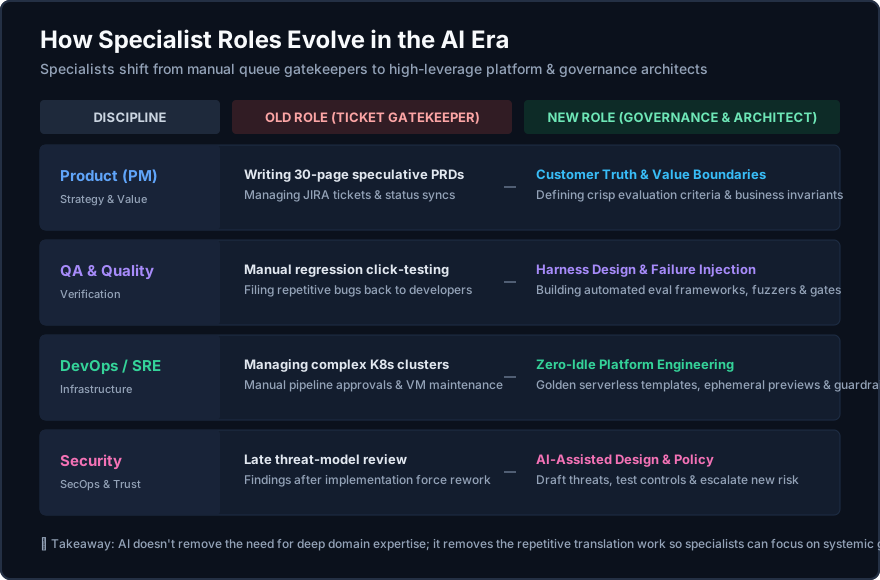
Security engineers: AI-assisted review and testable policy
Once a team has selected and integrated them, new tools widen what a builder can prepare without waiting for a security specialist. AI-assisted threat modeling can draft a diagram, candidate threats, and countermeasures from design material. AI code scanning can flag potential vulnerabilities in eligible pull requests, while autonomous application testing can probe a running system and return reproducible findings. These are examples of different capabilities, not a stack every team must buy. They extend the builder's first pass; they do not provide a complete security sign-off.
Consider a team that has already reviewed and approved a standard invitation design. Security engineers define its rules—administrator-only access, expiring links, and single-use tokens—along with a required security document template and the automated checks. The builder submits the architecture, data flow, roles, threats, mitigations, and links to tests in that format. The workflow can validate required fields and approved choices, then run permission and token tests plus code and dependency scans. If the change stays within the approved role, token, and data-flow boundaries and all required checks pass, the security gate can approve it automatically. A new role, token behavior, integration, or trust boundary routes the document to a security engineer. AI may help draft the document or flag findings; the team's reviewed policy determines the route. Field validation and passing scans cannot establish that every claim in the document is true or every threat has been found.
The efficiency gain has an upfront cost. Security and platform teams must choose tools that fit their systems, evaluate finding quality and data access, connect the tools to the development workflow, train builders to verify outputs, and define when to escalate. A small pilot should measure that setup effort alongside review time and missed risks. Until the workflow is reliable, adding tools can create another queue rather than remove one.
QA specialists: from regression testers to verification architects
For a change inside an approved pattern, AI can draft end-to-end and API tests while the builder checks the expected results and fills gaps. Required CI checks can then block a failing pull request without a routine manual QA sign-off. In the invite example, that removes the late QA handoff after the agreed permission, expiry, and one-time-use checks pass. A dedicated QA reviewer need not inspect every such change. Quality specialists, where a team uses them, can instead set coverage standards, improve shared test data and harnesses, study escaped defects, and review novel or higher-risk behavior. The team must still define when exploratory review is required; generated tests cover only the cases they encode.
DevOps and platform engineers: from configuration operators to golden-path builders
Platform engineers define the deployment paths that builders can use without needing to understand the underlying infrastructure deeply. Rather than managing bespoke configurations for each service, they build standardized templates—a production-ready deployment target, a CI pipeline pattern, an environment provisioning script—that any builder can adopt quickly. The goal is to make the safe path the easy path, so builders spend attention on product decisions rather than infrastructure debugging.
Product managers: from ticket coordinators to value boundary owners
PMs can remove a handoff by replacing a long implementation spec with a short brief: the customer problem, a measurable outcome, business constraints, and the decisions a builder may make without another approval. The builder can use AI to draft scope, acceptance criteria, and possible flows, then check those drafts against the brief and make routine product choices. For the invite example, the PM can define success as invitations that become active teammates while the builder chooses interface and implementation details within the approved access rules. The builder can reach a working preview without a PM approval queue; the PM resolves only open customer tradeoffs and checks whether the result serves the intended outcome. After release, the team measures adoption and adjusts. Customer discovery, prioritization, and the success measure remain product responsibilities. This gives a multi-functional builder room to act without turning every unclear detail into another ticket.
Design and engineering: reusable paths, end-to-end ownership
Designers can replace routine static-mockup handoffs with accessible components and interaction patterns that builders reuse. AI can draft an invite form from those patterns; the builder checks its behavior and carries the UI, API, and tests as one feature. Experienced engineers maintain shared contracts and architecture rather than taking a separate turn on every familiar change. Novel interactions or changes to shared boundaries still receive expert review. This removes routine design, frontend, and backend queues while keeping the standards those specialists created.
Four Guardrails for Safe Full-Lifecycle Ownership
Expanding an engineer's operational scope without rigorous guardrails is a recipe for invisible risk accumulation. Broader ownership means fewer independent pairs of eyes in the critical path. Make repeatable checks explicit and automated, and make the criteria for human review explicit as well.
- Machine-enforced API contracts: When one engineer defines both the API and the implementation, a silent schema change can break a client without a separate handoff catching it. Machine-readable contract definitions with automated linting and breaking-change detection can catch many such changes before merge. The contract becomes a boundary that other engineers and future builders can rely on, regardless of who wrote it.
- Non-negotiable CI gates: Each pull request should run the team's required automated checks before merge: type validation, static analysis, relevant unit and integration tests, and dependency vulnerability scanning. A failing required check blocks the merge under the team's repository rules. AI findings can help triage and suggest fixes, but should be verified before being treated as a merge gate. These checks catch repeatable mistakes; new design risks still follow the team's specialist-review policy.
- Ephemeral preview environments: Before a change reaches production, a builder should be able to verify it against representative infrastructure in an environment isolated from live data. Preview environments that provision automatically for a pull request and tear down afterward reduce environment-specific surprises, though they cannot reproduce every production condition.
- Explicit escalation criteria: Not everything is safe to ship autonomously. Teams should define ahead of time which changes leave an approved path and require specialist review—new authentication or permission behavior, billing or data-deletion paths, external data flows, or hard-to-reverse changes to stored user data. A routine change inside the reviewed invite pattern can follow required checks instead. These criteria should be written team policy, not left to individual judgment under shipping pressure.
A Practical Operating Model for Teams
How does an engineering organization actually make this transition? There is no single path, but a few patterns appear consistently in teams that do it well.
- Reduce operational surface area before expanding ownership scope. It is very difficult for one person to carry a feature end-to-end when the infrastructure requires constant specialist attention just to stay running. Teams that successfully move to multi-functional ownership almost always simplify their platform first—consolidating services, adopting managed infrastructure where it reduces operational burden, and retiring configuration that exists for historical reasons rather than current requirements.
- Define the builder's full scope explicitly. "One engineer can do everything" is not a policy—it is a vague aspiration that produces gaps. Put the PM's outcome, the builder's decision rights, required test and security checks, and escalation triggers on one page. State which artifacts the builder must produce and what "done" means before production. Pilot new tools on one real feature, train builders to question their output, and include integration and training time in the cost. Clarity about scope is what makes accountability real rather than nominal.
- Reorient specialist incentives toward builder enablement. Value reusable verification tools and timely reviews that catch important risks early. Counting approvals or blocked releases alone rewards the wrong behavior; counting only features that passed without specialist help would also discourage necessary review.
- Measure what actually matters. Track cycle time from decision to production deployment, not the number of tickets closed. Track change failure rate and recovery time, not the number of handoff approvals collected. The metrics you surface determine what behavior the team optimizes for.
Train Your Engineers for the Full-Lifecycle Model
Eliminating handoffs requires engineers with the systems discipline to own the entire cycle. Our hands-on classes equip developers with the technical rigor needed to build independently: executable specs, automated verification gates, type-safe schema contracts, and zero-idle cloud deployment.
Explore the Engineering Curriculum →