
In January 2024, Microsoft and the US Pacific Northwest National Laboratory published a result that looks like wizardry. AI models screened more than 32 million candidate battery materials, and physics simulations on Azure's supercomputers checked the most promising ones. The combined process narrowed the list to 23 candidates in about 80 hours, a search that, according to Science News, would have taken decades with traditional physics calculations alone. (Microsoft's own account reports 18 top candidates.) The team then made one of the candidates, a solid electrolyte that replaces some of the lithium with sodium, and built a working prototype battery.
That second step took about six months. In one project, finding the candidate took a few days and proving it took half a year.
That gap is the story of AI for science right now. The first wave of acceleration hit discovery: predicting, searching, and designing. The second wave is starting to hit verification: making, measuring, and testing. This article follows both, with examples, and asks what remains slow. It focuses on AI that designs physical things (drugs, materials, and proteins) and uses weather and mathematics as reference points, because there checking is already fast.
The First Wave: Discovery Is Already Fast
Start with what AI has already made faster, because it is substantial.
| Field | Before | With AI | Status |
|---|---|---|---|
| Protein structure | Often years and hundreds of thousands of dollars per structure | Minutes; over 200 million structures predicted | In everyday use by over 3 million researchers; 2024 Nobel Prize in Chemistry |
| Weather forecasting | Physics-based models on large supercomputers | About 1,000 times less energy per forecast; better on many measures | Operational at ECMWF since February 2025, alongside the physics model |
| Materials screening | Decades with physics calculations alone | 32 million to 23 in about 80 hours (AI plus simulation) | Prototype battery built; not a product |
| Early drug discovery | Typically 2.5–4 years to a preclinical candidate | 12–18 months on average across one company's 22 candidates | One drug in Phase III; no AI-discovered drug approved yet |
- Protein structures. Working out a protein's 3D structure once took several years and hundreds of thousands of dollars. DeepMind's AlphaFold does it in minutes. Its database holds more than 200 million predicted structures, nearly every catalogued protein, and DeepMind says more than 3 million researchers in over 190 countries use it. The work won the 2024 Nobel Prize in Chemistry.
- Weather. On 25 February 2025, the European Centre for Medium-Range Weather Forecasts (ECMWF) made its AI model, AIFS, operational. ECMWF says it beats leading physics-based models on many measures, with gains of up to 20% on tropical cyclone tracks, and uses about 1,000 times less energy per forecast.
- Drug discovery. Insilico Medicine used AI both to choose a disease target and to design the molecule for rentosertib, a drug for the lung disease idiopathic pulmonary fibrosis. Its Phase IIa trial results were published in Nature Medicine in June 2025. Across the 22 candidates Insilico nominated from 2021 to 2024, it reports an average of 12–18 months from project start to a preclinical candidate, compared with 2.5–4 years for traditional methods.
Now look at what each example leaves out. AlphaFold predicts a structure; it doesn't produce a drug. The battery material reached a prototype, but making it took six months. Rentosertib began Phase III in July 2026, and Insilico's own timeline puts approval in 2030 at the earliest; as of this writing, no AI-discovered drug has been approved. Even the AI weather model runs alongside the physics model rather than replacing it.
The first wave sped up the steps that are about thinking: predicting, searching, designing. It did much less for the steps that are about checking: making, measuring, testing in people.
Why Verification Was the Bottleneck
A prediction is a hypothesis until it's checked. Google DeepMind's GNoME project reported 2.2 million predicted crystal structures in Nature in November 2023. In April 2024, UC Santa Barbara chemists Anthony Cheetham and Ram Seshadri examined a sample and found "scant evidence for compounds that fulfill the trifecta of novelty, credibility, and utility." DeepMind stood by its paper and noted that hundreds of the predicted materials had been made independently. Both can be true. AI models also need checking because physics can't be learned "roughly": an EPFL study (ICML 2025) showed that an AI model of atomic forces that doesn't conserve energy makes simulated water heat itself up from nothing.
How discovery actually runs: a loop, not a funnel
In practice, the work is a division of labor. Physics simulation teaches: supercomputers run large numbers of quantum-mechanical calculations, and AI models learn from the results. The AI makes the first guesses, screening far more candidates than simulation alone could. Physics simulation checks the AI's best guesses. But simulation is itself an approximation, so the final verdict comes from the lab. The results of every check, including failures, go back into the AI's training data, and the loop runs again.
Here is that loop for an illustrative battery team that starts with 50,000 AI-proposed solid electrolytes. The counts and times are rough orders of magnitude, not measurements.
| Step | What it checks | Time per candidate | How it typically fails |
|---|---|---|---|
| 0. Generate (50,000) | Nothing yet. The model proposes structures it scores as stable and conductive. | Milliseconds | Near-copies of known compounds; structures that only look stable to the model. |
| 1. Rule filters (8,000) | Charge balance, element cost and supply, toxicity, overlap with known databases. | Milliseconds | Rules too loose (junk passes) or too strict (interesting outliers get cut). |
| 2. AI screen (600) | An AI model trained on simulation data estimates stability and ion mobility. | Seconds to minutes | Energy drift; chemistry outside the training data scored with false confidence. |
| 3. Simulation check (80) | Full quantum-mechanical (DFT) calculation on the survivors. | Hours on a supercomputer | Known DFT errors for some chemistries; stable on paper is not the same as makeable. |
| 4. Synthesis (12) | Can anyone make it, by a route that might scale? | Days | A different phase forms; the target only appears under conditions no plant could run. |
| 5. Characterize and test (3) | X-ray diffraction confirms the structure; test cells are built and cycled. | Weeks | Ambiguous data read as success; it works alone but degrades in a real cell. |
| 6. Scale-up (0–1) | Grams to tonnes: yield, purity, cost, safety, supply chain. | Months to years | Works in the lab, fails economics; needs process know-how no dataset contains. |
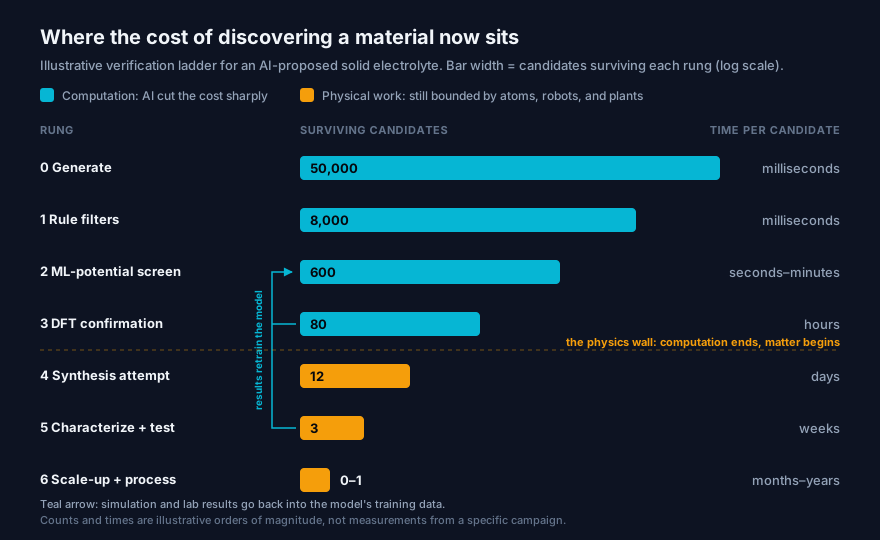
Above the dashed line, the first wave already did its work. Below it, every step needs physical assets: labs, instruments, experienced chemists, factories. And the data that improves the AI at the top comes from those lower steps, including failed experiments that are rarely recorded. That is why speeding up verification matters so much: it doesn't just shorten the bottom of the ladder, it feeds the whole loop.
The Second Wave: Verification Is Speeding Up
The physics wall is not standing still. The checking side of science is starting to change in three ways: AI is taking over the handoffs between steps, robots are speeding up the checks themselves, and robots are learning to work from a stated goal instead of a programmed routine.
1. AI connects the steps
In most industrial work today, people connect the steps. An AI model screens candidates on a GPU cluster, researchers pick a shortlist, the shortlist goes to simulation on a supercomputer or cloud cluster, and researchers decide what goes to the lab. The machines are often separate, supercomputer time is queued, and trusting a prediction is a judgment call. Each handoff can add days or weeks. (Practice varies by company and is rarely disclosed.)
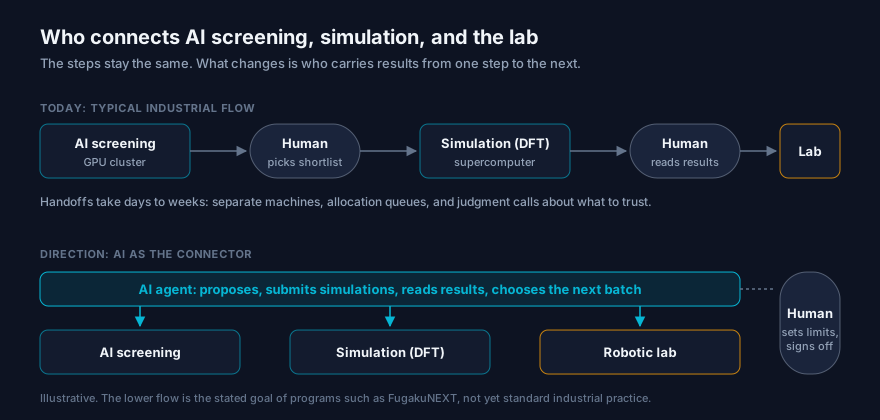
Major public programs are building toward AI agents that do the connecting. Japan's FugakuNEXT, targeted for around 2030, aims to automate hypothesis generation and testing, and puts Fujitsu CPUs and NVIDIA GPUs in one system so AI and simulation share a machine. Japan's science ministry named decision support for AI agents through high-precision simulation a priority in its October 2026 Fugaku policy. Like any autonomous system, a science agent needs limits: a compute budget, a person's sign-off before anything is synthesized, and a running count of how often slower checks confirm its predictions. That confirmation rate decides how much autonomy it earns.
2. Robots speed up the checks themselves
The second change goes below the physics wall. Autonomous labs, in which robots run experiments and AI analyzes the results and picks the next one, are starting to compress the physical steps.
- Materials synthesis. Berkeley's A-Lab ran for 17 days of continuous operation and reported synthesizing 36 of 57 target compounds (Nature, 2023). AI proposed recipes from the literature, read the X-ray diffraction data, and designed follow-up attempts when yields were low.
- Cell biology. In a 2022 study from RIKEN and collaborators, the lab robot Maholo, guided by AI, searched a space of some 200 million culture conditions for turning stem cells into retinal cells. It took 185 days, against more than two and a half years for people doing the same work, and raised differentiation efficiency from about 50% to 90%.
- Dedicated robot labs. In April 2026, Institute of Science Tokyo opened a center in Tokyo where 10 robots, including Maholo, run medical experiments with no on-site staff: dispensing reagents, operating temperature-controlled equipment, and culturing cells. It plans to grow to about 2,000 robots by 2040 and to combine them with an AI platform covering everything from hypothesis to experimental verification. Google DeepMind's planned UK lab aims to synthesize and characterize hundreds of materials per day, with Gemini models planning the experiments.
- Clinical trials. Robots can't make a drug work faster in the body, but AI can shrink trials. In 2022 the European Medicines Agency qualified Unlearn's PROCOVA method, which uses AI-generated "digital twins" of patients to cut control-arm sizes by up to 35% in Phase II and III trials.
Two limits remain. Physical time constants don't compress: a furnace still takes hours, cells still take days to grow, and a 52-week trial still takes 52 weeks. What robots compress is the waiting for people, and the number of experiments that can run in parallel. And automated checking needs checking of its own. Soon after A-Lab's paper appeared, crystallographer Robert Palgrave argued that several of its AI-based phase identifications were wrong. The lab's leader, Gerbrand Ceder, conceded that "a human can perform a higher-quality [XRD] refinement on these samples" (VentureBeat).
3. Robots that work from a goal
The third change is in how robots are instructed. Lab automation has traditionally meant programming every motion, which only pays off for experiments repeated many times. That is starting to change.
- Plain instructions. In 2023, RIKEN and Osaka University demonstrated a camera-equipped robot arm that builds a 3D model of a cluttered lab bench and generates its own motions from instructions such as "drop 100 µL of the solution in container 1 onto sample A." In a test on 96 plants, it completed every application except one on a poorly grown plant, though it mistook two leaves for one in three cases.
- A goal, not a procedure. Carnegie Mellon's Coscientist (Nature, 2023) was given goals such as "perform multiple Suzuki reactions." Using GPT-4, it searched the literature, planned the synthesis, wrote code for a liquid-handling robot, fixed its own errors, and ran the reactions, which were confirmed by analysis. People still moved plates by hand, and the authors withheld full code and prompts for safety reasons.
- The direction. RIKEN researchers describe a lab where a scientist states an intention, such as comparing which of two cell types grows faster, the lab's AI proposes a plan based on available stock, and the lab runs it once the scientist approves. They are targeting a one-room implementation by the end of fiscal 2027, and team director Ryo Ozaki calls the prospect an era of "a hundred million researchers", in which anyone could run experiments by stating what they want to learn.
Much of this is still research or plans rather than routine practice, and claims about it are often inflated. Read carefully, the direction is clear: the checking layer is getting faster, more parallel, and easier to instruct, with a person still signing off at each step.
How Fast, Industry by Industry
Both waves move at different speeds in different industries. Ordered from the fastest checks to the slowest:
1. Mathematics and weather: checked in seconds or days
A proof can be checked by machine, which is why systems such as DeepMind's AlphaProof reached silver-medal level at the 2024 International Mathematical Olympiad so quickly. A forecast checks itself when tomorrow arrives. Because verification here was never the bottleneck, faster discovery turned directly into practice: AI weather forecasting is in public operational use, and it is the clearest case of AI for science already serving everyone.
2. Industrial biology: checked in days to weeks
Discovery: protein language models now propose new enzymes and proteins directly. EvolutionaryScale's ESM3 model is offered free for non-commercial use and commercially through AWS and NVIDIA, and Cradle sells protein design as software so that customers can run many design cycles quickly while keeping their IP (eWeek; TechCrunch). Verification: lab tests take days to weeks, short enough that robots running many experiments in parallel pay off quickly. Maholo's 185-day culture search in regenerative-medicine research shows the kind of gain possible in biological lab work. Of the physical industries, this is the one where both waves fit together most naturally.
3. Materials and chemicals: checked in weeks, scaled in years
Discovery: the 32-million-candidate battery search shows what is now possible. CuspAI in Cambridge, UK, which raised $450 million in July 2026, works like a search engine for materials, and pools data, labs, and compute with more than 40 companies, including Nvidia, Meta, Samsung, and Hyundai, to speed the loop for all of them. Verification: autonomous labs such as A-Lab and DeepMind's planned UK lab are compressing synthesis and testing, and some companies are skipping the handoff to manufacturers altogether: Orbital Industries (London and San Francisco) says "We don't sell that software" and instead sells AI-designed materials and hardware itself. Still slow: scale-up to production, and adoption. In a 2025 survey of Japanese manufacturers by the trade publication MONOist, 90% had not adopted materials informatics.
4. Drug discovery: checked in years
Discovery: the first wave is clearest here. Insilico's 12–18 months to a preclinical candidate compares with 2.5–4 years, and Isomorphic Labs, Alphabet's London-based spinout from DeepMind, builds its drug design on AlphaFold 3, keeps it in-house, and raised a $2.1 billion Series B in May 2026. Verification: the second wave reaches only part of the way. AI-designed control arms can make trials smaller, and pharma companies are pooling data to train better models without sharing it, as in Japan's LINC consortium, which combines models trained on data from 16 companies. But a drug still has to work in a human body over months, which is why the first AI-discovered drugs are only now reaching Phase III.
Who Captures the Speed
Faster discovery and verification don't benefit everyone equally. AI-for-science companies turn speed into revenue in five main ways:
| Model | What's sold | Works when | Examples |
|---|---|---|---|
| Tool / SaaS | Software subscriptions or licenses; the customer owns the discoveries. | Customers run many iterations and want to own their IP. | Matlantis, Cradle, NVIDIA BioNeMo |
| Platform + consortium | Search over a design space, backed by partners who pool data, labs, and compute. | No single company has enough data or lab capacity alone. | CuspAI's AI Materials Foundry; LINC (data consortium) |
| Discovery contract | Candidates for a partner's target; upfront fee, milestone payments, royalties. | One success is worth billions, and the buyer has a pipeline to absorb it. | Isomorphic Labs, Insilico Medicine |
| Own product / pipeline | The drug, material, or device itself. | Software alone can't capture the value, and capital is available. | Orbital Industries, Periodic Labs, Lila Sciences |
| Open release | Nothing directly; value comes from hardware sales, reputation, or ecosystem. | The publisher profits from widespread use, not from the model. | AlphaFold 2, Meta's UMA and ESM |
The pattern across them: the best models are increasingly kept in-house or inside partnerships, while earlier models become open or cheap. So the advantage is concentrating not around models but around what turns model output into results: labs and clinical capacity, proprietary data (especially failures), capital to run the loop, and the ability to organize consortia. Investors and governments are funding exactly these. Periodic Labs raised a $300 million seed round to build autonomous labs. The US Genesis Mission had more than $5 billion in federal commitments by July 2026 and named Japan its first international partner, and the EU launched RAISE in October 2026 to pool compute, models, and data.
The second wave pulls both ways. Autonomous labs are expensive, so in the near term they strengthen whoever can afford them. But robots that take plain instructions or goals lower the cost of automating experiments, and if robotic labs become rentable services, owning one matters less. Which force wins is the biggest open question.
What Could Change This Picture
Signals to watch
Verification becomes a service. If robotic labs cut synthesis and testing from days to hours, goal-driven robots become reliable, and both can be rented, the second wave spreads to everyone and owning a lab stops being an advantage. Watch for independently confirmed discoveries and verified operating results, not announcements and plans.
Automated checks prove unreliable. If autonomous labs keep producing results that human experts later overturn, as with A-Lab's disputed phase identifications, the second wave will slow and human verification will stay the bottleneck.
The first wave doesn't convert. If AI-discovered drugs fail in late-stage trials at the usual rates and AI-designed materials don't reach production, faster discovery will turn out to have mostly produced faster hypotheses.
Data stops being private. If consortia, open datasets, or regulation make experimental data, including failures, broadly shared, the loop speeds up for everyone and the data advantage shrinks.
So, Will Science Become Wizardry?
Yes, one field at a time, and at the speed of verification. Where answers can be checked by a machine or by tomorrow's weather, AI is already turning years into minutes. Where they have to be checked in a furnace, a factory, or a clinical trial, the magic slows at the physics wall. That wall is moving, though: AI agents are shortening the waiting between steps, and robots are starting to speed up and simplify the checks themselves. What they can't compress is the time physics and biology need.
Put the three stages together and the picture is one of acceleration moving down the chain from idea to impact:
- Discovery has already sped up dramatically. Structures, candidate materials, and drug molecules that once took years to find now take minutes, days, or months.
- Verification is next. AI agents are taking over the handoffs between steps, robotic labs are running experiments around the clock and in parallel, and robots are starting to work from a stated goal rather than a programmed routine.
- Industrial application is starting to follow where the first two have caught up. AI weather forecasts are in public operational use, AI-designed materials are being sold as products, consortia are pooling data and labs to shorten the path to market, and the first AI-discovered drug is in Phase III.
What sets the final pace is what AI can't compress: how long a reaction takes, how fast cells grow, how long a trial must run, and how long it takes to scale a process from grams to tonnes. The first wave made proposing cheap. The second wave is making checking faster. Those who own and improve the checking, and the path from a verified result to production, will turn the magic into products. Those who own only the wand will end up with long lists of beautiful hypotheses.
Sources
- Science News: AI helped scientists create a new type of battery (Microsoft and PNNL, Jan 16, 2024)
- Microsoft Azure Blog: How Microsoft's AI screened over 32 million candidates to find a better battery (Jan 9, 2024)
- Google DeepMind: AlphaFold impact, database, and 2024 Nobel Prize
- ECMWF: AI forecasts become operational (Feb 25, 2025)
- Insilico Medicine: rentosertib Phase IIa results in Nature Medicine (Jun 2025)
- Rentosertib Phase III start and approval timeline (Jul 2026)
- Cheetham & Seshadri, "Artificial Intelligence Driving Materials Discovery? Perspective on the Article: Scaling Deep Learning for Materials Discovery," Chemistry of Materials (2024)
- The Register: GNoME critique and DeepMind's response (Apr 11, 2024)
- Bigi, Langer & Ceriotti, "The dark side of the forces" (arXiv; ICML 2025)
- RIKEN: FugakuNEXT initiative (Aug 22, 2025)
- MEXT: Fugaku operating policy, revised Oct 1, 2026 (Japanese, PDF)
- Szymanski et al., "An autonomous laboratory for the accelerated synthesis of novel materials," Nature (2023)
- VentureBeat: A-Lab critique and response (Dec 2023)
- RIKEN: Robot and AI optimize stem-cell culture conditions (Jun 2022)
- Interesting Engineering: Institute of Science Tokyo robot lab (May 2026)
- Fortune: Google DeepMind's UK automated lab (Dec 10, 2025)
- Clinical Trials Arena: EMA qualifies Unlearn's PROCOVA (Sep 2022)
- RIKEN and Osaka University: generative AI system for autonomous experiments (Dec 2023, Japanese)
- Boiko et al., "Autonomous chemical research with large language models," Nature (2023)
- RIKEN Closeup: self-maintaining automated labs and "a hundred million researchers" (Mar 2026, Japanese)
- eWeek: Cradle's $73M AI software strategy
- TechCrunch: EvolutionaryScale and ESM3 (Jun 2024)
- Tech.eu: CuspAI $450M Series B (Jul 20, 2026)
- Dealroom: Orbital Industries $50M Series B (May 2026)
- MONOist: Materials informatics survey 2025 (Feb 2026, Japanese)
- Healthcare Markets & Technology: Isomorphic Labs $2.1B Series B (May 2026)
- IT Business Today: Elix and LINC federated-learning platform (Jul 2025)
- TechCrunch: Periodic Labs $300M seed (Sep 30, 2025)
- AI Weekly: Genesis Mission commitments (Jul 2026)
- RIKEN: Japan–US AI for Science partnership (Jun 5, 2026)
- European Commission launches RAISE (Oct 2026)
Build the Verification Step First
Whether the generator writes code or proposes crystals, the return comes from checking its output cheaply and reliably. Our hands-on classes teach that discipline for software: executable specs, automated verification gates, type-safe contracts, and gated deployment pipelines.
Explore the Engineering Curriculum →