
Picture a leadership offsite in late 2026. The board wants evidence that last year's AI spend is working. Finance has a slide titled "AI efficiency program" with one number on it: a 12% reduction in engineering and support headcount. The press release is already drafted. It says the company is "becoming an AI-native organization."
Before that slide becomes a decision, the engineering leader in the room should be able to answer four questions. Did the AI investment create capacity the company can measure? Does the return depend on removing people, or on what people do next? Is AI the real reason for this cut? And what knowledge walks out the door with the people leaving? Gartner's 2026 research doesn't answer these for any specific company. It does show what happens, at scale, when organizations skip them.
What Gartner Actually Found
Four findings get repeated in coverage of this research, sometimes loosely. Here is what each source supports, and what it doesn't.
1. Cutting headcount didn't separate high-ROI adopters from the rest
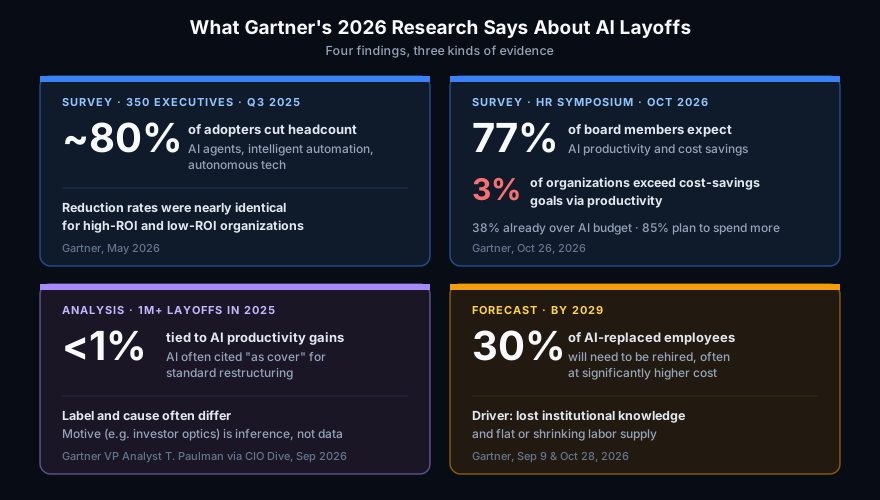
In a May 2026 release (the Japanese edition of a global release from May 5), Gartner reported a survey of 350 executives worldwide, conducted in Q3 2025. Respondents came from organizations with roughly $1 billion or more in annual revenue that were piloting or had deployed AI agents, intelligent automation, or other autonomous technologies. About 80% of those organizations had reduced headcount. But the rate of reduction was nearly the same whether an organization reported high ROI from these technologies or little to none. Distinguished VP Analyst Helen Poitevin's point, as the release puts it, is that the organizations improving ROI are not the ones making people redundant. The underlying report has a blunt title: AI Layoffs Aren't Paying Off; People Amplification Is.
What this doesn't show: that layoffs lower ROI. The finding is that headcount reduction didn't distinguish the winners from the rest. That's enough to undercut the "cut people, get returns" story, but it's a correlation from one survey, not a controlled comparison.
2. Boards expect savings; 3% of organizations exceed their goals
On October 26, 2026, at its HR Symposium, Gartner released research titled "77% of Board Members Expect AI to Deliver Productivity and Cost Savings, Yet Just 3% of Organizations Exceed Cost Savings Goals Via Productivity." According to reporting on the release, 38% of organizations are already over budget on AI, and 85% still plan to spend more on it in 2027. Senior Director Analyst CV Viverito was direct: "Ultimately, organizations will not generate cost savings from AI at this point."
What this doesn't show: that AI produces no productivity gains. Viverito's framing is more precise: "There isn't a struggle to create capacity, that's happening already as organizations redesign work. What organizations are struggling with is how to make that capacity usable and redirecting it to what is valuable." The gap is between freed-up time and money on the books, not between AI and zero.
3. Layoffs credited to AI productivity were under 1% of the total
Gartner VP Analyst Tori Paulman told CIO Dive that Gartner analyzed more than one million layoffs from 2025. Layoffs tied to AI productivity gains, meaning fewer workers needed because AI made each one more productive, were under 1% of the total. Paulman said companies citing AI for layoffs were likely using it "as cover" for standard restructuring. She also said that "Agentic AI is not taking over a significant enough portion of work" to explain the cuts being attributed to it.
What this doesn't show: why companies credit AI. A common explanation is that "we're becoming AI-native" plays better with investors than "we over-hired" or "the business slowed." That's plausible, but it's our inference about motives, not a Gartner finding.
4. Gartner predicts 30% of AI-replaced roles will be refilled by 2029
In its September 9, 2026 future-of-work release, Gartner predicted that by 2029, 30% of employees laid off because AI replaced their work will need to be rehired, often at significantly higher cost. Gartner repeated the prediction in an October 28 release on workforce planning. Its reasoning: cuts drain institutional knowledge and talent pipelines, and with labor force growth flat or declining in many regions, buying that expertise back will cost more than keeping it would have. The September release also predicts that by 2027, 75% of organizations that treat AI productivity gains mainly as cost savings will be overtaken by competitors that reinvest those gains.
What this doesn't show: anything that has already happened. Both numbers are forecasts, so treat them as Gartner's analyst judgment rather than observed rates. Early cases do exist, though. CIO Dive points to Klarna, which replaced about 700 customer service agents with AI in 2024 and had begun rehiring people by early 2026.
Why "Fewer People, Same Output" Doesn't Add Up to Returns
The AI-layoff business case usually runs on a simple chain: AI makes each person X% more productive, so we need X% fewer people, so costs fall by X% of payroll, so returns rise. Each link in that chain has a gap.
- Productivity gains arrive as hours, not money. A tool that saves an engineer six hours a week produces six scattered hours, not a sixth of an employee you can remove. Turning those hours into a smaller team requires the work itself to be reorganized. That's the redesign step Viverito describes, and it's where organizations are struggling.
- A cut is a one-time step down in cost; it doesn't grow anything. Removing salary lowers cost once. It doesn't create new products, new customers, or faster delivery of what already earns money. Gartner's ROI finding is consistent with that: the organizations getting returns are the ones putting freed-up capacity into new work.
- AI costs are rising at the same time. With 38% of organizations already over their AI budgets, a payroll saving can be partly or fully offset by spending on models, tooling, integration, and the people needed to run them.
- The remaining team inherits the work AI doesn't do. Exceptions, escalations, reviews, and failures stay with people. If the cut was sized to the average case, those people are now short-handed for the hard cases. We explored the delivery-side version of this in Redesign the Work Before You Reduce the Team.
None of this means a cut can never pay off. It means the payoff depends on things the cut doesn't do. That explains why headcount reduction alone didn't distinguish the high-ROI organizations in Gartner's survey.
When "AI" Is the Label, Not the Cause
Calling a restructuring an "AI efficiency program" has costs that land on engineering, even when the restructuring itself is justified.
Suppose a company cuts 10% of its platform team because demand slowed, but announces the cut as AI-driven. The remaining team now has an implied target: deliver the old output with fewer people, thanks to AI. No one measured whether AI could close that gap, because AI wasn't why the cut happened. In the next planning cycle, the team either misses a target that was never real, or meets it by cutting corners in review, testing, and on-call coverage. The second outcome is worse, because it looks like success until something breaks.
There's a second cost. If the business slowdown was the real reason, calling it AI hides that problem from the people who need to fix it. Gartner's under-1% figure suggests that, across 2025, this mislabeling was the norm rather than the exception.
The practical rule for engineering leaders: if a cut is coming for non-AI reasons, push for it to be described that way internally, even if the external message differs. Plans should be built on the actual reason.
The Boomerang: Knowledge Walks Out First
The rehiring forecast rests on something engineering teams know well: much of what keeps a system running isn't written down anywhere.
Take an illustrative example. A billing integration has a retry rule that waits 90 seconds instead of the standard 5 before retrying one payment provider's webhooks. No ticket explains why. The engineer who wrote it knows the provider double-sends under load, and a fast retry creates duplicate charges that support then has to reverse by hand. An AI assistant reading the code sees an odd constant and suggests "fixing" it. A reviewer who never learned the history approves the change. The first sign of trouble comes weeks later, as a spike in refund tickets.
That's the kind of loss Gartner means when it warns about institutional knowledge. Its September release names "deepening context, judgment and meaning" as one of four future-of-work shifts. It recommends keeping the reasoning behind processes, not just the processes, with human oversight attached. Rehiring doesn't fully fix this. A new hire at a higher salary still has to rediscover the 90-second rule, often by triggering the incident it was written to prevent.
If a role is going to change or go away, capturing that reasoning first is cheap: decision records for non-obvious rules, runbooks that explain why as well as what, and a walkthrough recorded by the person leaving. It is far cheaper than rebuilding it from incidents afterward.
What Gartner Recommends Instead
Gartner's alternative is what it calls a "talent remix": using AI to move people out of lower-value tasks and into new work, rather than cutting deep and early. Paulman summed up the stakes this way:
"When business and IT executives look back on the early AI-era, they will realize their greatest mistake was believing that work automation was the point, when workforce amplification was the opportunity."
In an engineering organization, a remix might look like this. These are illustrative moves, not Gartner prescriptions:
- Support engineers to self-serve tooling. If AI now handles first-line ticket triage, the people who used to triage know which failures repeat. They can build the diagnostics, docs, and product fixes that stop those tickets from arriving.
- Feature builders to the backlog nobody had time for. Most teams have a list of integrations, migrations, or product bets that kept losing priority. Freed capacity can go there, ideally where it ties to revenue or retention you can measure.
- Senior engineers to verification. When drafting gets cheap, review, testing, and architecture become the constraint. That's where experienced judgment pays off, as we argued in Code Is Cheap, Judgment Is Scarce.
The test is whether the redirected capacity shows up somewhere the business can see it: shipped features, retained customers, fewer incidents, faster delivery. If it doesn't show up, the remix has failed as well, just more slowly.
Where This Breaks
When a Cut Can Still Be the Right Call
This is not an argument that AI-era companies should never reduce headcount. If a business is truly over-staffed or losing money, a reduction may be necessary whether or not AI is part of the picture. The point is to name it honestly and plan for it as what it is.
Some work really is automated end to end, such as high-volume, low-exception processing where AI handles the full task and the exceptions are rare and well understood. There, a smaller team may be the correct outcome once the automation has been measured in production, not just piloted.
A talent remix can also fail. Redeployed people need real work and real skills to do it. Moving people into vague "innovation" roles with no measurable outcome only postpones the decision and adds cost. Give any remix a deadline and success criteria, as you would any other investment.
The evidence has limits too. Gartner's ROI finding comes from a single survey of large organizations. The 3% figure measures organizations exceeding cost-savings goals via productivity, which is a demanding bar. And the 30% rehire rate is a forecast. Taken together, these findings justify skepticism toward AI-justified cuts. They don't prove every such cut will fail.
A Decision Record Before Any AI-Attributed Cut
Below is an illustrative decision record for a hypothetical proposal. Its purpose is to make the assumptions visible before the decision, while they can still be tested. The company, team, and numbers are invented.
Proposal: Reduce the 14-person customer integrations team to 10, citing AI coding assistants and an AI support agent.
1. Is the capacity real and measured?
Claim: Assistants made engineers "30% faster."
Evidence: PR count up 34% over two quarters. End-to-end lead time for an integration request unchanged at 19 days. Most of that time is spent waiting on partner credentials and security review.
Finding: Drafting got faster; delivery didn't. The capacity isn't yet usable.
2. Does the return depend on the cut, or on what comes next?
Payroll saving: 4 roles. Offsetting costs: AI tooling renewal, a contractor for partner escalations, and the risk of slower delivery on the two partner launches tied to Q2 revenue.
Alternative: Move 2 engineers to a self-serve credential flow aimed at the 19-day wait, and measure lead time after one quarter.
3. Is AI the actual reason?
The integrations budget was already flagged for cuts because two partners churned. Finding: This is partly a demand correction. Record it as such, and don't set an AI productivity target for the remaining team that was never measured.
4. What knowledge leaves?
Two of the four proposed departures are the only people who have handled a specific partner's legacy SOAP API and its undocumented rate limits.
Mitigation, if the cut proceeds: Decision records and recorded walkthroughs before the notice period ends, plus a named owner for that partner.
Decision: Reduce by 2 for the demand correction, labeled as such. Redeploy 2 to the credential flow with a one-quarter deadline. Revisit with lead time, escalation volume, and partner-launch dates as the success criteria.
The structure matters more than the specific answers. It separates the four claims that usually get bundled into "AI lets us do more with less." If any one of them can't be answered with evidence, the AI part of the justification isn't ready.
The decision rule is short. Treat AI-freed capacity as an asset to reinvest until you can show, in end-to-end measures, that it has turned into lower cost of the work itself. Cut only for reasons you would state honestly without AI in the sentence. Write down what the departing people know before they go. Gartner's 2026 research suggests most organizations are doing it the other way around: cutting first and looking for the returns afterward.
Sources
- Gartner Japan press release on AI layoffs and ROI (May 2026, Japanese)
- Gartner: 77% of Board Members Expect AI to Deliver Productivity and Cost Savings, Yet Just 3% of Organizations Exceed Cost Savings Goals Via Productivity (Oct 26, 2026)
- TechRadar: coverage of the HR Symposium findings (Oct 28, 2026)
- Gartner Identifies Four Shifts Shaping the Future of Work (Sep 9, 2026)
- Gartner Predicts 30% of Employees Replaced by AI Will Be Rehired by 2029 (Oct 28, 2026)
- CIO Dive: One-third of AI-replaced workers will be rehired by 2029 (Sep 16, 2026)
Turn Freed Capacity Into Shipped Work
Reinvesting AI capacity only works if engineers can own more of the delivery cycle safely. Our hands-on classes teach the discipline that takes: executable specs, automated verification gates, type-safe schema contracts, and production deployment pipelines.
Explore the Engineering Curriculum →